Voice of America as a U.S. public diplomacy tool
For various economic and political reasons, the U.S. government uses Soft Power (international influence through culture, values, and foreign policies) via public diplomacy. In this context, the government utilizes the broadcasting support of Voice of America (VOA) to reinforce the country's public diplomacy toolkit.
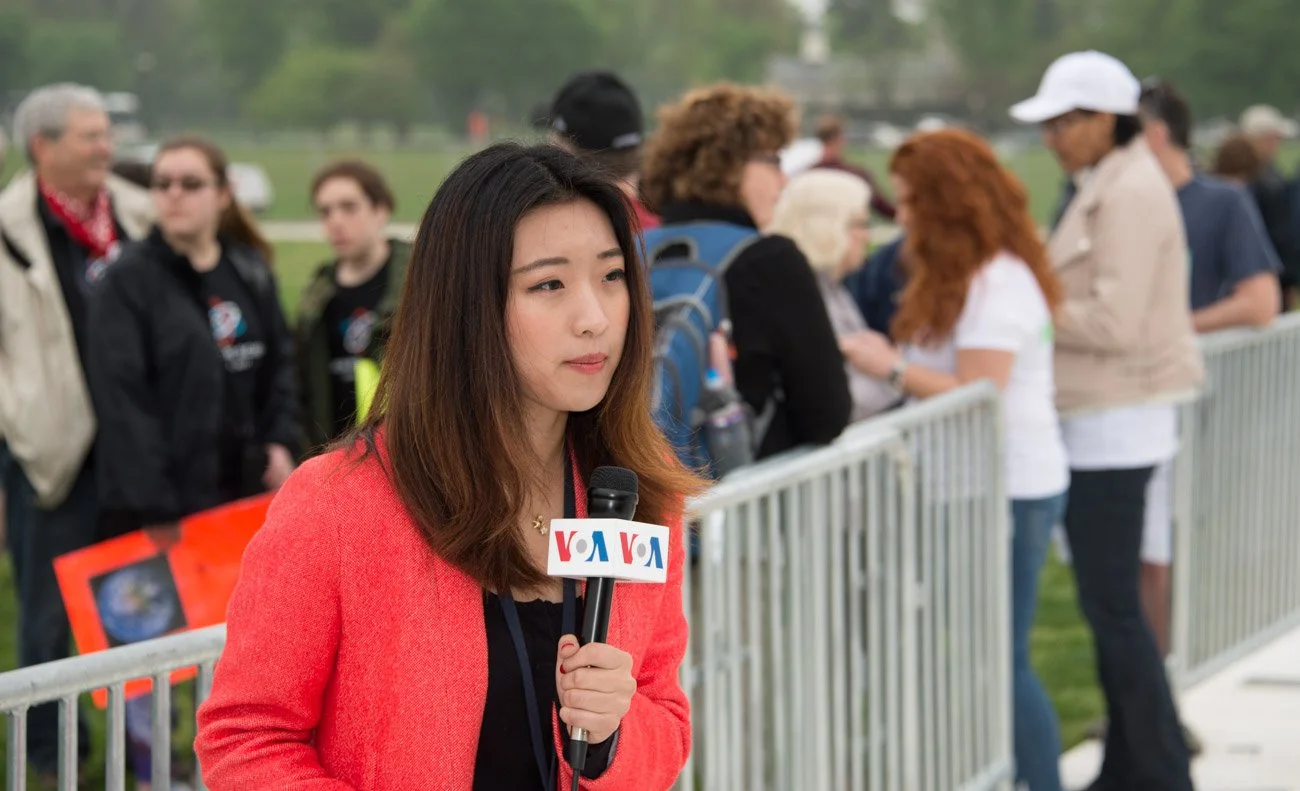
Voice of America - image libre de droits
Voice of America: "The Principle of the Free Press"?
Voice of America describes itself as "the largest U.S. international broadcaster, providing news and information." It produces digital, televised, and radio news in 44 languages, reaching a weekly audience of over 354 million people. The news is broadcast through a network of more than 3,500 affiliate stations worldwide, mainly in Africa, the Middle East, Eastern Europe (the Balkans), Afghanistan, Pakistan, South Asia, and Latin and South America. Created in 1942, this broadcaster is owned and operated by the U.S. government. While VOA claims to provide a "comprehensive coverage of the news" and to "tell audiences the truth," it has often been criticized for its lack of objectivity, for heavily supporting U.S. government policies—especially concerning foreign policies—and for being its "obvious propaganda" in favor of the president in power. The broadcaster has also been involved in several corruption scandals.
Since 1948, a law has prohibited Voice of America from broadcasting directly to U.S. citizens, in order to avoid direct influence from the U.S. government on its own population. This law reveals the intended focus on international influence through this information dissemination system. Thus, as a tool of public diplomacy, VOA aims to engage foreign audiences and shape public opinion in favor of the U.S. (as a dominant global news center) and its foreign policy goals. It is clear that the use of multiple media channels now plays a crucial role in influencing foreign stakeholders, as theorized by Golan, Manor, and Arceneaux (2019). This strategic interaction between governments and the media highlights that global competition for media framing is central to international relations.
The effectiveness of Voice of America
Voice of America, being a state-run organization, is not a profit-driven enterprise, so its effectiveness cannot be measured through financial metrics. Neither its annual revenue nor its audience size directly reflects its impact. Therefore, we must look at other factors. Through VOA, the U.S. attracts global news attention, suggesting that other countries admire the country’s values. However, news attention is not equivalent to attraction.
An alternative measure of international news flow is influence: the extent to which a country’s news media can set the agenda for foreign media. With this element, we can assess whether Voice of America influences the topics covered by foreign media, thereby evaluating its effectiveness. Zhang and Blanchard (2022), observe that the U.S. influences the media agendas of China and Russia, as well as many other countries. In his 1951 article, Kohler mentions former Soviet countries, Western European nations, and Asian countries that cited VOA as a trustworthy and objective source. The primary goal of this state-controlled tool is not to spread false information or boast about the merits of the United States, but to establish itself as a credible long-term source, ultimately enhancing the country’s diplomatic image and power without using force.
We also understand the strong visibility and undeniable presence of the United States in international media. Beyond being a primary economic and political actor, the country has developed an overwhelmingly powerful media network, forcing media outlets worldwide to reference and relay U.S. information. This makes the U.S. even more visible and thus more powerful internationally, through the dissemination of its values and foreign policies.
To illustrate this concept, let's analyze an article from VOA’s website about the U.S. blocking the sale of advanced equipment to China by imposing new restrictions. The article emphasizes the ongoing tension between the two countries, framing it under the pretext of national security, rather than as a part of the broader global U.S./China competition. By stressing the potential military and surveillance uses of these technologies by China, the U.S. government justifies its actions as a defense against national security risks. This framing reflects a broader trend in media coverage of controversial policies, where national security concerns are often presented as more legitimate and less politically charged than international conflicts. The VOA report carefully includes opposing perspectives from both the U.S. administration, which defends these measures, and China, which condemns the sanctions as economic coercion. This presentation shows how VOA frames the information in a way that supports U.S. interests, rather than objectively covering the news.
Another example of how VOA covers news to support U.S. soft power is its framing of the September 11, 2001, events. At the time, the editorial team faced strong pressure from the U.S. government not to disseminate interviews or testimonials from individuals connected to terrorism or muslims. A year later, for the first anniversary of the attacks, VOA posted an article asking people from Arab countries (such as Egypt and Somalia) for their opinions about the attacks. One person, for example, said, "I’m Egyptian and Muslim. I want to say that all Egyptians condemn these killings. God help America." This statement, highlighting the religion of the interviewee, strongly aids the U.S. image in international media. The implication here is that all Muslims agree with the U.S. viewpoint or later regret their actions. It draws a link between anti-US islamist terrorists and Islam. VOA effectively suggests that there are no divergent opinions—only one perspective, the "correct" one.
When we consider the effectiveness of this state-controlled broadcaster, it is clear that giving a voice to an individual Egyptian can amplify the perception that the entire Muslim community holds these views, which is a much more powerful tool than fighting terrorism with firearms. Moreover, many people around the world rely on VOA as their only source of information, as it is often the only available media outlet. This raises the question of whether it serves peace or only furthers the interests and power of the U.S. government.
Through these examples and the brief overview of VOA, we can understand that the broadcaster is not only effective but also a strong engine for public diplomacy and soft power. We can now legitimately question whether such a tool is a disseminator of disinformation and whether it is acceptable to use it to preserve peace, or merely to protect one’s own interests or power.